







 IncomeDebt
Filter
Income / Debt Ratio Filter (IncomeDebt)
Find financially strong companies by income-to-debt ratio in real time with Trade Ideas Streaming Alerts (Scanner) and Top Lists (Screeners). The Income/Debt Ratio compares a company's income to its total debt, a read on financial strength and leverage.
Watch the market turn, stock by stock.
Free account, just an email. No card. Live access for a limited time.

Seeing a financially strong stock start to move as it happens helps active traders. The Income / Debt Ratio filter value changes once a day, so Streaming Alerts apply it the moment each alert fires: you see only the stocks that pass it, while they are moving.
How Trade Ideas finds it: set the minimum value to 20 to see only stocks with an income/debt ratio of 20/1. See Trade Ideas plans and pricing to run it live.
How the Income / Debt Ratio filter works
The income/debt ratio is a financial metric used to assess a company's financial strength and leverage by comparing its income to its total debt. Here's a detailed explanation of the "Income/Debt Ratio" filter:
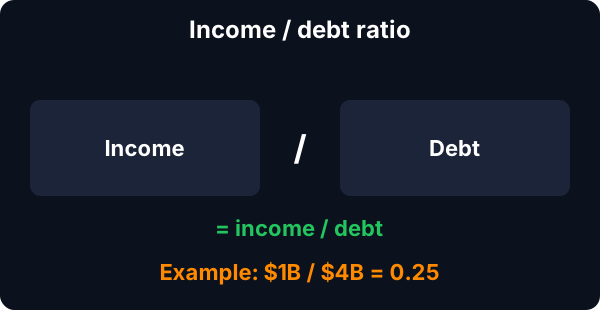
Definition: The income/debt ratio measures the relationship between a company's income and its total debt. It is calculated by dividing the company's income (such as net income or operating income) by its total debt. The formula for the income/debt ratio is: Income / Debt
This ratio provides insights into the company's ability to generate income relative to its debt obligations.
Interpretation:
Key point
Larger Value: A higher income/debt ratio indicates that the company generates more income relative to its total debt. This suggests that the company has sufficient income to cover its debt obligations comfortably, reflecting strong financial health and lower leverage. A larger value is generally viewed positively as it indicates a lower degree of financial risk associated with debt.
Smaller Value: Conversely, a lower income/debt ratio suggests that the company's income may be insufficient to cover its debt obligations adequately. This indicates higher leverage and may raise concerns about the company's ability to service its debt payments, especially during periods of financial stress or economic downturns. A smaller value implies higher financial risk and potential vulnerability to debt-related challenges.
Income / Debt Ratio filter settings
Settings
Configuring the "Income/Debt Ratio" filter is simple and can be done within the Window Specific Filters Tab of the Configuration Window in your Alert or Top List (Screener) window.
Here's how to set up the filter in your configuration window:
- Set the minimum value to 20 to see only stocks with an income/debt ratio of 20/1.

Using the Income Debt Ratio Filter
The "Income/Debt Ratio" filter can be used in various trading strategies, including:
- Leverage Analysis: Traders can use the income/debt ratio to assess a company's leverage level and financial health. By comparing the income/debt ratios of different companies within the same industry or sector, traders can identify companies with lower leverage and potentially lower financial risk. Trading strategies may involve buying stocks of companies with higher income/debt ratios and selling short stocks of companies with lower ratios, betting on relative strength or weakness in leverage.
- Sector Rotation: Traders may employ sector rotation strategies based on income/debt ratios. They can identify sectors or industries with companies exhibiting strong income/debt ratios and allocate capital accordingly. Sector rotation strategies involve shifting investments into sectors with favorable income/debt ratios and away from sectors with weaker ratios, aiming to capitalize on trends in financial health and leverage across industries.
- Quality Investing: Quality investing strategies focus on investing in high-quality companies with strong financial fundamentals, including healthy income/debt ratios. Traders may screen for stocks of companies with high income/debt ratios relative to their peers and industry averages. Quality investing strategies involve building a portfolio of fundamentally sound stocks with attractive income/debt ratios, aiming to achieve consistent returns over the long term.
Filters to combine with Income / Debt Ratio
Categories
FAQ
Which companies earn the most relative to their debt?
Add the Income / Debt Ratio filter (IncomeDebt) to a Trade Ideas Streaming Alerts or Top List (Screener) window. Set the minimum value to 20 to see only stocks with an income/debt ratio of 20/1.
What is the Income / Debt Ratio filter?
The Income/Debt Ratio compares a company's income to its total debt, a read on financial strength and leverage.
What is a good income to debt ratio for a company?
Use the Income / Debt Ratio filter (IncomeDebt) in Trade Ideas Streaming Alerts and Top Lists to find financially strong companies by income-to-debt ratio. The Income/Debt Ratio compares a company's income to its total debt, a read on financial strength and leverage.