







 Float
Filter
Float Filter (Float)
Find low float stocks, or large-float stocks, by the number of shares available to trade, in real time, with Trade Ideas Streaming Alerts (Scanner) and Top Lists (Screeners). Float is the number of a company's shares available for trading in the market. The Float filter screens by that share count.
Watch the market turn, stock by stock.
Free account, just an email. No card. Live access for a limited time.

Seeing a low float stock start to run as it happens helps active traders. The Float filter value changes once a day, so Streaming Alerts apply it the moment each alert fires: you see only the stocks that pass it, while they are moving.
How Trade Ideas finds it: adjust the minimum value to 1,000,000,000 to see only stocks with a more substantial float size. Adjust the maximum value to 10,000,000 to see only stocks with a float of 10,000,000 or less. See Trade Ideas plans and pricing to run it live.
How the Float filter works
In stock trading, the "float" refers to the number of shares available for trading in the market. The float filter focuses on identifying stocks with specific characteristics related to their float size, which can provide insights into their liquidity, volatility, and potential trading opportunities.
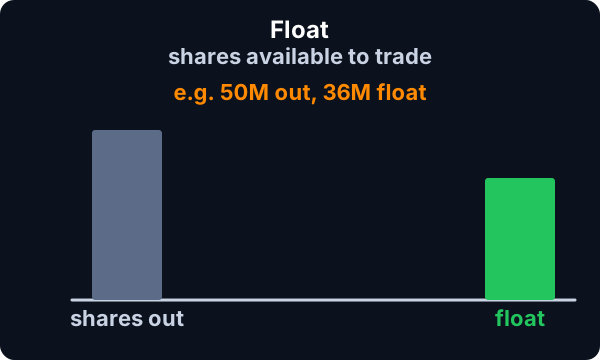
Here's how float works:
- Definition of Float: The float represents the total number of shares of a company's stock that are available for trading on the open market. It excludes shares held by insiders, such as company executives and major shareholders, as well as shares held by institutional investors or restricted from public trading.
- Calculation of Float: The float is calculated by subtracting the restricted shares, insider holdings, and other non-tradable shares from the total outstanding shares of a company. The resulting number represents the float or the shares available for trading among the general public.
- Filtering Process: The float filter involves screening stocks based on their float size. Traders may set specific criteria to identify stocks with float characteristics that align with their trading strategies. For example, they may filter for stocks with a small float (low float stocks) or those with a large float (high float stocks).
- Interpretation of Float: The size of a stock's float can have significant implications for trading dynamics and price movements. Stocks with a small float tend to be more volatile and have limited liquidity, making them prone to sharp price swings. Conversely, stocks with a large float often have greater liquidity and stability but may exhibit slower price movements.
Float filter settings
Configuring the "Float" filter is simple and can be done within the Window Specific Filters Tab of the Configuration Window in your Alert or Top List (Screener) window.
Here's how to set up the filter in your configuration window:
- Adjust the minimum value to 1,000,000,000 to see only stocks with a more substantial float size.
- Adjust the maximum value to 10,000,000 to see only stocks with a float of 10,000,000 or less.

Using the Float Filter
The "Float" filter can be used in various trading strategies, including:
Momentum Trading:
- High Float Stocks: Momentum traders may target stocks with a high float for their relatively stable price movements and liquidity. They may look for stocks with strong upward or downward momentum and initiate trades in the direction of the trend, aiming to capitalize on short-to-medium-term price swings.
- Low Float Stocks: Momentum traders may also target stocks with a low float for their potential to experience rapid and exaggerated price movements. These stocks can exhibit strong momentum due to supply and demand imbalances, presenting opportunities for quick profits through short-term trades.
Range Trading:
- High Float Stocks: Traders may employ range trading strategies on stocks with a high float that tend to trade within well-defined price ranges. They may buy near support levels and sell near resistance levels, taking advantage of the stock's stability and predictable price movements.
- Low Float Stocks: Range trading may be more challenging with low float stocks due to their heightened volatility. However, traders can still look for opportunities to trade within established price ranges, using technical indicators and market sentiment analysis to identify potential entry and exit points.
Breakout Trading:
- High Float Stocks: Breakout traders may seek opportunities in high float stocks that exhibit significant price movements beyond key technical levels or chart patterns. They may wait for the stock to break out of consolidation phases or trade above resistance levels, aiming to ride the momentum generated by the breakout.
- Low Float Stocks: Breakout trading can be particularly lucrative with low float stocks, as they are prone to sharp and rapid price movements. Traders may look for breakout opportunities following periods of consolidation or on the back of positive news catalysts, entering trades with tight stop-loss orders to manage risk.
Filters to combine with Float
Categories
FAQ
Show me low float stocks moving today?
Add the Float filter (Float) to a Trade Ideas Streaming Alerts or Top List (Screener) window. Adjust the minimum value to 1,000,000,000 to see only stocks with a more substantial float size. Adjust the maximum value to 10,000,000 to see only stocks with a float of 10,000,000 or less.
What is the Float filter?
Float is the number of a company's shares available for trading in the market. The Float filter screens by that share count.
How do I find low float stocks with high volume?
Use the Float filter (Float) in Trade Ideas Streaming Alerts and Top Lists to find low float stocks, or large-float stocks, by the number of shares available to trade. Float is the number of a company's shares available for trading in the market.